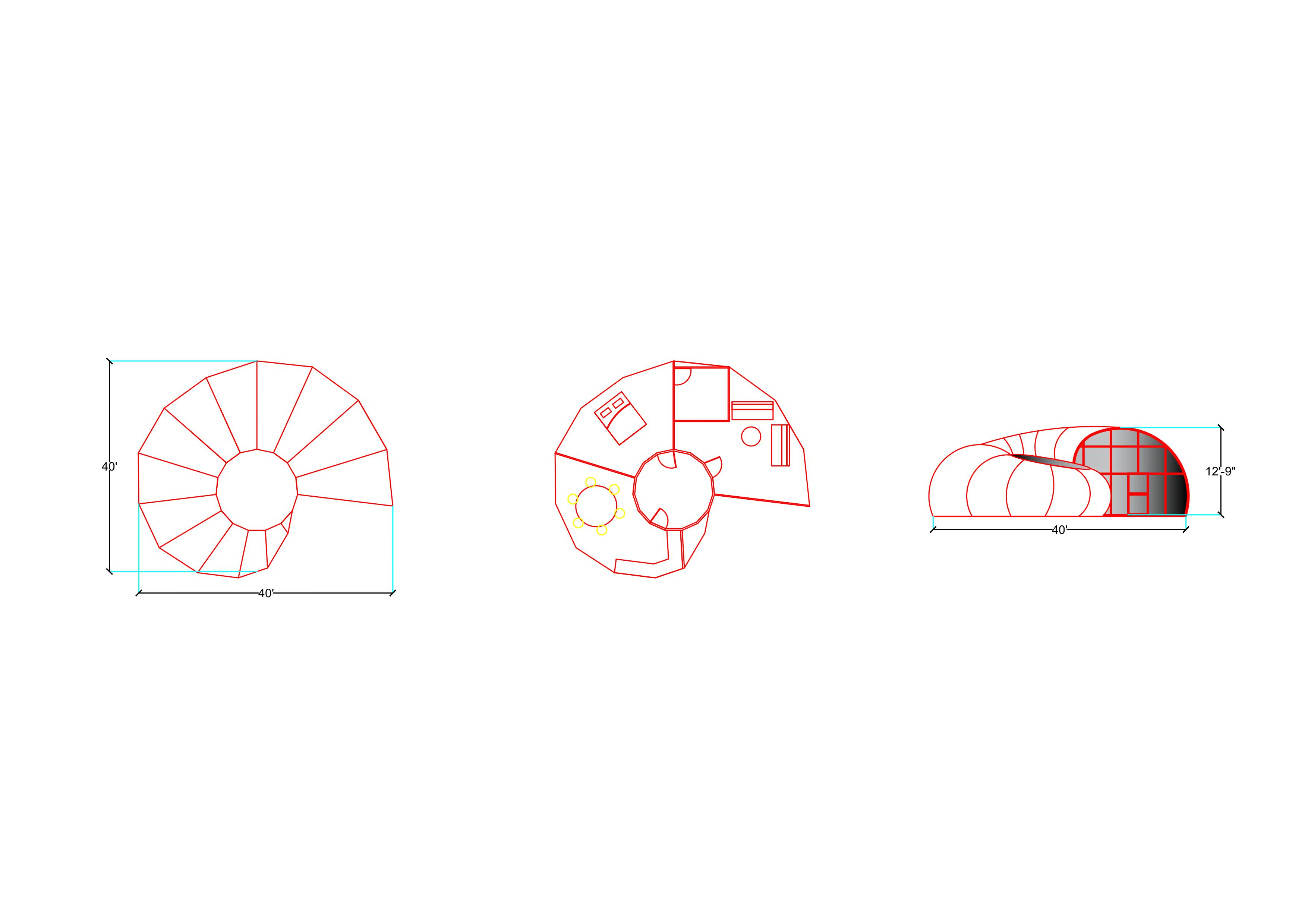
SNAIL DESIGN ANALYSIS
Concept & Structural Evolution
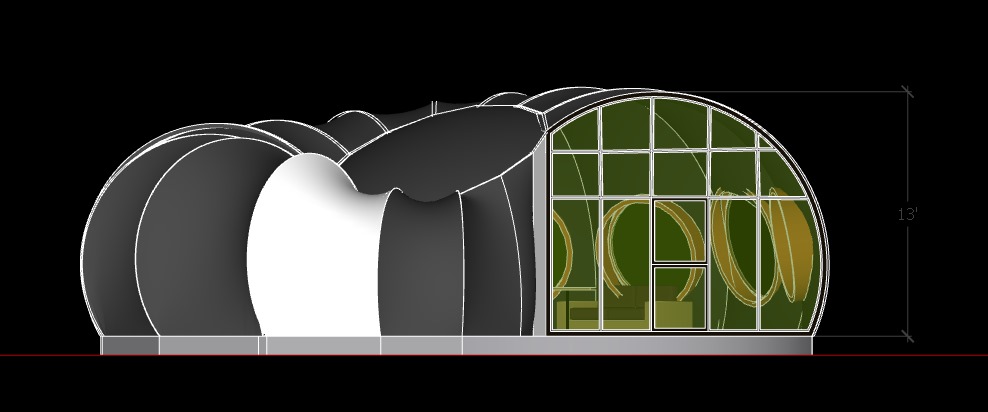
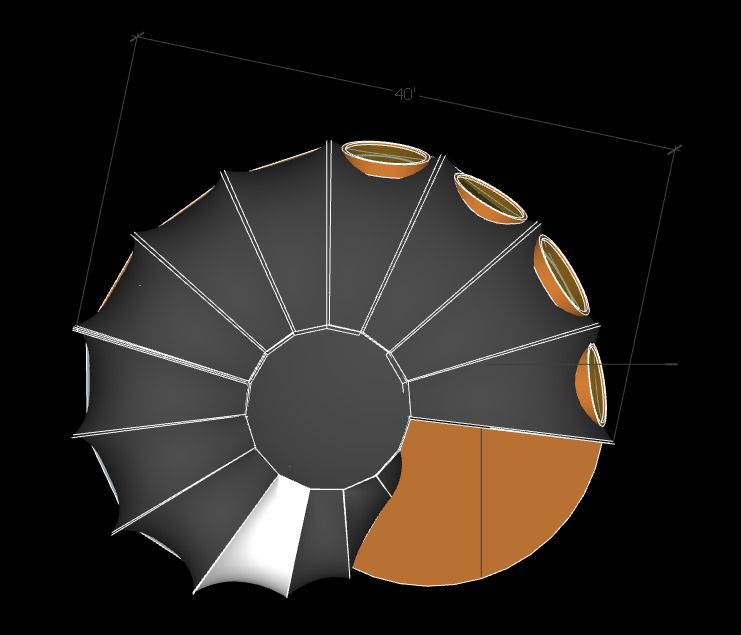
Based on the provided dimensions (13-foot height and 40-foot diameter),
the Snail structure currently functions as a pavilion or single-storey
residence rather than a high-rise. However, its organic spiral geometry
offers strong potential for vertical scaling when reinterpreted as a
multi-level architectural concept.
1. Biomorphic Design Concept — The Snail Shell
The architecture follows principles of biomorphic and biophilic
design, inspired by the Nautilus and natural snail shells.
-
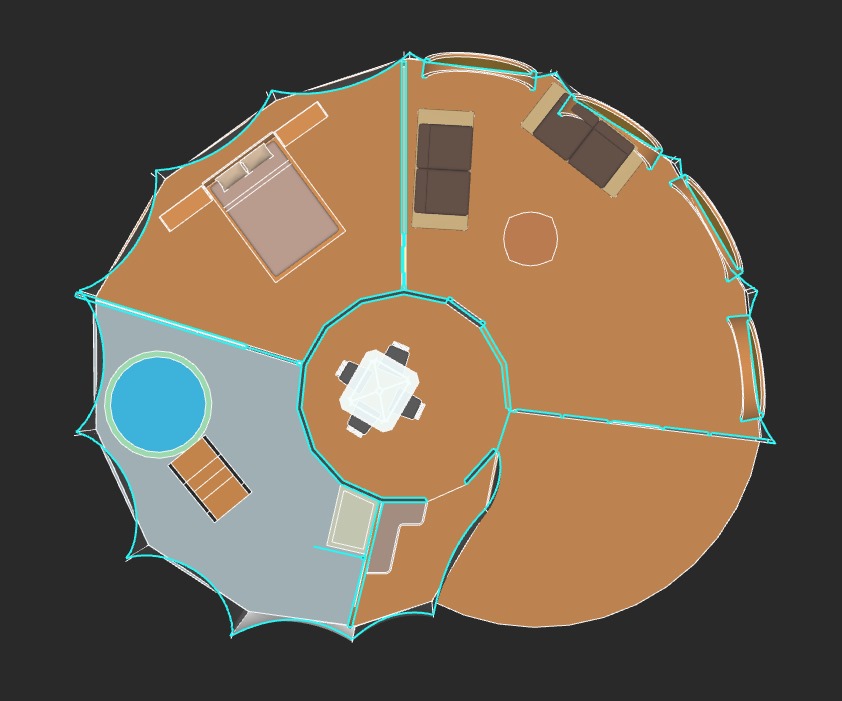
Fibonacci Spiral: The floor plan radiates outward
from a central core in a logarithmic spiral, allowing spaces to
expand organically.
-
Vertical Translation: In a high-rise adaptation,
this spiral would translate into stacked or rotating floor plates
around a central structural spine.
-
Spatial Flow: The spiral layout creates intuitive
circulation and a continuous spatial experience.
2. Shell Geometry & Exterior Expression
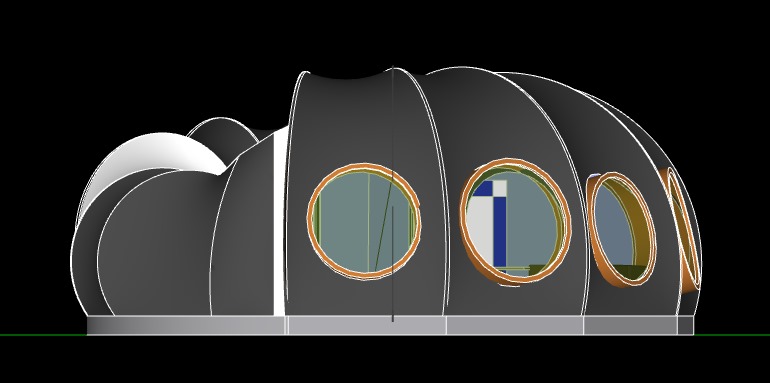
The exterior envelope is composed of segmented, bulging panels that
reflect natural shell growth patterns.
-
Segmented Shell: Mimics the layered growth rings of
a snail shell, creating rhythmic massing.
-
Visual Identity: Breaks away from conventional flat
facades and glass-box typologies.
-
Shading & Depth: Panel articulation provides
self-shading and reduces solar gain.
3. Fenestration Strategy & Light Control
Window placement balances privacy, daylight, and panoramic views.
-
Porthole Windows: Circular apertures create intimate,
protected interior zones.
-
Glazed Sections: Larger grid-based glazing opens up
communal spaces to landscape views.
-
Light Modulation: Openings are distributed to guide
daylight along the spiral path.
4. Structural & Functional Evolution (High-Rise Adaptation)
-
Central Core: The circular nucleus becomes a vertical
circulation hub housing elevators, stairs, and services.
-
Aerodynamics: The curved exterior naturally sheds
wind loads, reducing vortex shedding in tall structures.
-
Terracing: The spiral geometry enables stepped
terraces, allowing green spaces at multiple levels.